Abstract
Image inpainting aims to restore or modify missing regions in images, but evaluating the perceptual quality of inpainted results remains challenging because valid completions can be diverse and a unique ground-truth reference is often unavailable in practical scenarios. Existing no-reference IQA and MLLM-based IQA methods provide promising alternatives, but they are generally designed for global image quality and lack explicit awareness of the restored region.
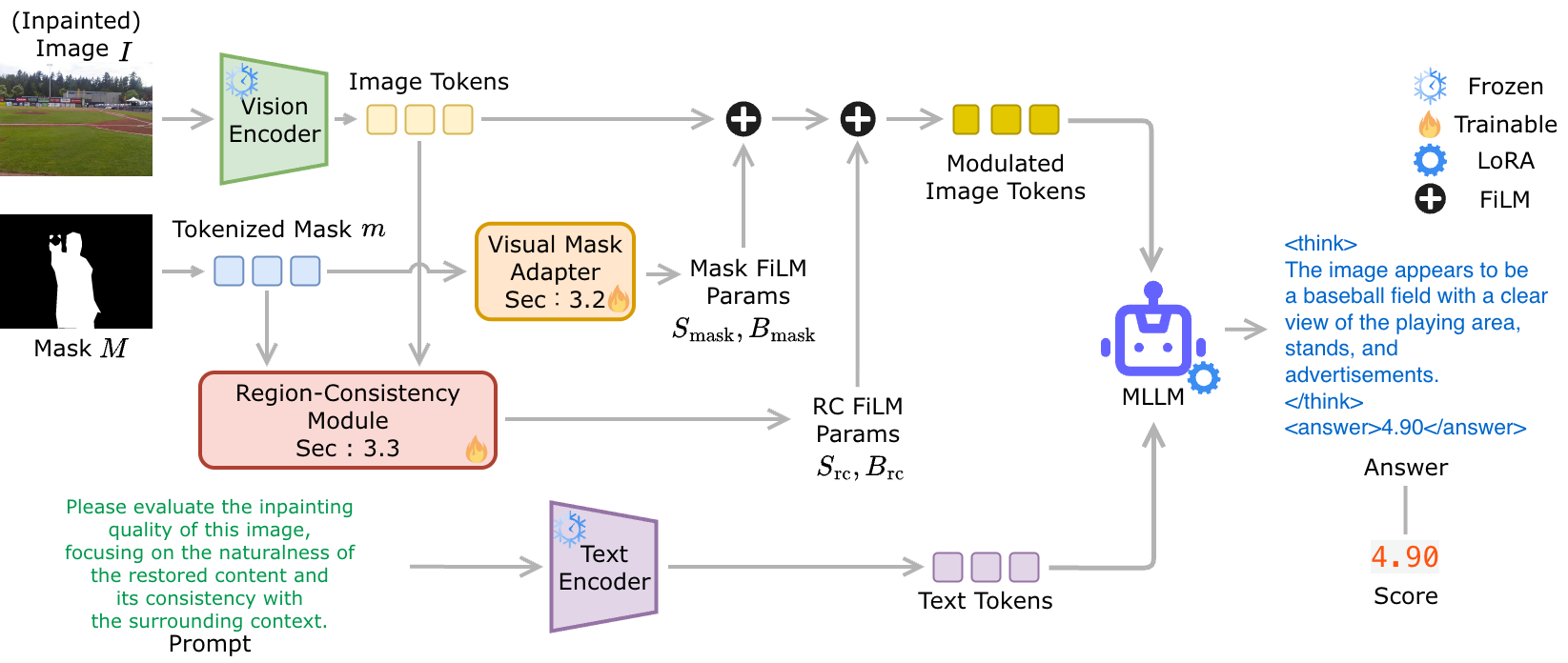
To address this limitation, we propose MAIQ, a mask-aware framework for no-reference inpainting quality assessment. MAIQ extends MLLM-based IQA by using the inpainting mask as spatial guidance, combining token-level visual modulation with region-level consistency modeling between the restored region and its surrounding context. Experiments on NIQAD, a human-rated benchmark of 8,000 images generated by diverse inpainting methods, show that MAIQ achieves stronger correlation with human perceptual judgments than representative NR-IQA, object erasure, and reasoning-based IQA baselines.
Method
1. Visual Mask Adapter
The token-level mask is mapped to token-wise FiLM scale and shift parameters. Unlike hard masking, background tokens are preserved, so the model keeps full-image context while learning which features matter for the restored region.
2. Region-Consistency Module
Channel-wise means and standard deviations of tokens inside and outside the mask form an inner-outer descriptor, which is projected to region-level FiLM parameters applied only to restored-region tokens.
3. Reasoning & Rewards
Built on VisualQuality-R1-7B, MAIQ outputs a reasoning trace and a score. GRPO-style training combines format, differential ranking, and absolute-score rewards, with LoRA on the LLM decoder.
NIQAD Dataset
8,000
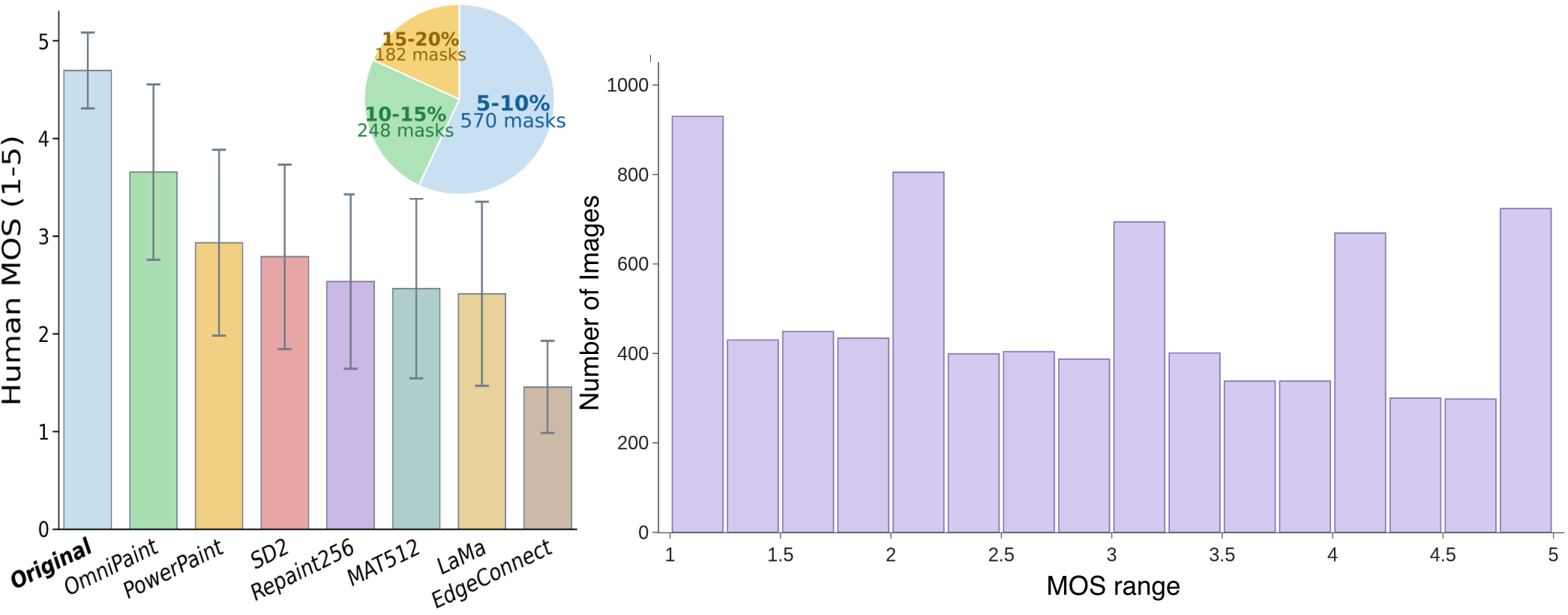
Images: 1,000 COCO originals and 7,000 inpainted results
7
Inpainting methods, from GAN-based to diffusion-based
40,000
Ratings from 167 annotators, five per image
The Naturalness-based Inpainting Quality Assessment Dataset (NIQAD) masks COCO objects covering 5–20% of the image and inpaints them with MAT, EdgeConnect, LaMa, RePaint, PowerPaint, SD2-inpainting, and OmniPaint. Annotators rate perceptual naturalness as a standalone image on a 5-point scale.
Results
0.758
SRCC with human MOS on the NIQAD test set
+0.066
SRCC gain over the strongest baseline (TOPIQ)
0.665
Zero-shot SRCC on CelebAMask-HQ inpainted images
| Method | SRCC ↑ | PLCC ↑ |
|---|---|---|
| QualiCLIP | 0.456 | 0.418 |
| DBCNN | 0.639 | 0.644 |
| MANIQA | 0.677 | 0.681 |
| TOPIQ | 0.692 | 0.693 |
| Q-Align w/ original prompt | 0.545 | 0.552 |
| Q-Align w/ inpainting prompt | 0.558 | 0.563 |
| Q-Align w/ mask prompt | 0.570 | 0.575 |
| Q-Hawkeye | 0.290 | 0.292 |
| VisualQuality-R1 zero-shot | 0.354 | 0.282 |
| VisualQuality-R1 | 0.604 | 0.597 |
| ReMOVE | -0.082 | -0.085 |
| MAIQ (Ours) | 0.758 | 0.752 |
Quantitative comparison on NIQAD. Trainable image-only baselines are re-trained on NIQAD.
| Variant | SRCC ↑ | PLCC ↑ |
|---|---|---|
| MAIQ full | 0.758 | 0.752 |
| w/o Visual Mask Adapter | 0.692 | 0.685 |
| w/o Region-Consistency Module | 0.717 | 0.708 |
| w/o Abs reward | 0.746 | 0.738 |
| w/o Diff rank reward | 0.743 | 0.751 |
Ablation study. Removing the Visual Mask Adapter causes the largest drop, and both reward terms contribute.
Qualitative Analysis
Citation
@InProceedings{Koshimoto_MAIQ_WACV2027,
  author = {Koshimoto, Yota AND Uchiyama, Taiki AND Isogawa, Mariko},
  title = {{MAIQ: Mask-Aware No-Reference Image Quality Assessment for Inpainting}},
  booktitle = {Proceedings of the IEEE/CVF Winter Conference on Applications of Computer Vision (WACV)},
  year = {2027}
}